When JD Wallace lost both of his parents within 18 hours of each other, his world shattered. “That impacted me greatly,” JD says. “Struggling at work, struggling personally—I needed help.” That’s when someone from his church reached out and invited him to a GriefShare group. JD didn’t know it at the time, but accepting that invitation would change everything.
The profound loss of both parents led JD to healing—and a calling.
JD walked into his first GriefShare session not expecting much. “It’s certainly not anything I would have probably normally chosen to do,” he admits. But the impact was immediate. “I started getting benefits from it right away.”
Over time, JD not only found healing but also a surprising sense of calling. “I told my pastor, ‘I feel called in some way to give back to the church in this area. I have no idea what that would look like, but I’ve benefited so much from my participation.’”
On a church trip to Israel, JD’s pastor posed a question that would push him far outside his comfort zone: “Have you ever thought about being a facilitator for GriefShare?”
JD’s immediate answer? “No, that’s farthest from my thought process.”
Many people feel they have nothing to give after experiencing loss.
In the wake of deep grief, it’s common to feel empty—like you have nothing left to offer. JD felt that too. He prayed and considered his next steps. “This is way outside my comfort zone,” he told his pastor. “But I won’t know unless I try. I had to trust that the Holy Spirit would equip me for the task.”
That trust became the foundation for a decade of ministry.
JD stepped out of his comfort zone and found his purpose.
In the fall of 2014, JD led his first GriefShare group. “I was like a deer caught in the headlights,” he laughs. “I had done all the training, but managing group dynamics was tough.” Still, he stuck with it. Encouraged by his pastor and affirmed by group members who commented he was making a difference, JD led 22 groups over ten years.
And when COVID hit, JD adapted. He launched an online group, reaching participants as far away as Louisiana and Dallas. “Our church had to pivot quickly, and I actually continued online even after we resumed in-person. It helped us reach people we wouldn’t have otherwise.”
Eventually, JD helped expand the GriefShare ministry across multiple campuses of his church. Today, several satellite locations run groups—some even in Spanish—and GriefShare has new leaders who were once participants themselves.
“I had to trust that the Holy Spirit would equip me for the task.”
JD says stepping into leadership felt overwhelming at first. “But as the weeks went on, I kept getting feedback: ‘You’re doing a good job. You’re helping.’ That made me want to keep going.”
His journey wasn’t just about leading—it was about mentoring others, too. “One of our current facilitators came out of a group I led. That’s probably how it occurs at most churches—someone experiences healing through GriefShare and then feels called to help others in the same way.”
After ten years of faithfully leading, JD recently stepped away from facilitating. “I prayed a lot about it. I feel like God has called me to do something else, but I’m still a huge supporter of the program.”
Listen to JD share his story:
Ready to turn your healing into ministry?
 JD’s story is a powerful reminder that God doesn’t waste our pain. Through GriefShare, He brings healing, and then invites us to offer that same comfort to others.
Are you sensing a nudge, like JD did, to step out and serve?
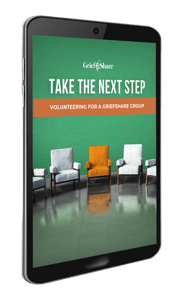
Download this guide designed to answer your questions and help get you started.